Formula Milk Guide
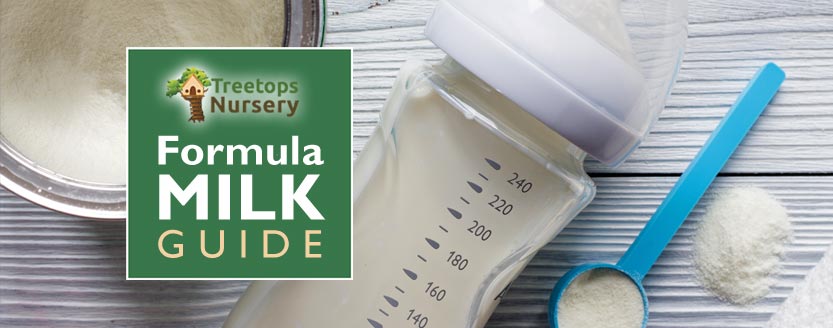
 Last month, we mentioned what a huge topic formula milk is. So, in this post, we thought we’d explore all the different types of milk available to infants in the UK.
As a rule of thumb, the best type of milk for your baby is breast milk, given in tandem with suitable Vitamin D supplement drops. We’ve written a separate post about the benefits of breast milk here. Suffice it to say, though, that breast milk is best and has an enormous number of health benefits to both mother and child, including many that simply can’t be achieved by formula milk. That said, there are many reasons why formula milk may be the only viable option and we’ll explore the different types available in our Formula Milk Guide below.
First, though, some words of warning. There are several types of milk that you should never give to your baby if they’re under 12 months old.
Milk Types to Avoid Giving Babies Under 1
- Condensed milk a.k.a. ‘Evaporated milk’ should be avoided. This is milk (usually from cows) that has been thickened by evaporating off about 60% of the water. It is usually also sweetened by adding sugar and has a slightly darker colour than standard milk.
- Dried milk a.k.a. ‘Powdered milk’ or ‘Milk powder’ should also be avoided. This is liquid milk that has been evaporated until it’s turned into dry powder.
- Cow’s milk, goat’s milk and sheep’s milk should also not be given to babies under 12 months of age except when used in cooking and only then when it’s been pasteurised. After the age of 1 it’s OK to drink so long as it’s pasteurised.
- Soya milk, Oat milk, Rice milk and Almond milk, along with other similar drinks described as ‘milks’, should be avoided by babies under one.
- Rice drinks should also be avoided right up to the age of 5 due to the presence of arsenic.
What Types of Formula Milk Can Your Little One Drink?
 Baby and infant formula milk comes ready-made in liquid form or as a powder that needs to be carefully and hygienically made up. The liquid variety is usually the more expensive of the two and needs to be used sooner, due to its shorter shelf life. Whichever is used, labels should be carefully checked to ensure suitability for the age of the particular baby/infant in question.
Note too, that there are many kinds of formula milk and one could argue that many of them are simply attempts by manufacturers to introduce niche products that appeal to a particular market or situation. As you’ll see, however, according to the NHS, some of the
 More and more parents are bringing up youngsters as vegetarians these days, so we thought we’d put together a rough guide to raising babies, toddlers and preschoolers as vegetarians. When doing so, certain considerations will need to be made, including ensuring that meals are nutritious, containing all the necessary food groups, vitamins and minerals needed by the very young.
 The good news is that formula milk that’s suitable for vegetarians is available. Parents may ask their midwife or health professional for any recommendations in regard to types or brands, particularly if one formula milk disagrees with the baby. However, whichever brand and type is chosen, the formula milk must be formulated for the baby’s specific age. This is usually obvious on the product label.
 Of course, that can be the case. What’s more, such handheld screens are a great way for parents to keep children entertained when perhaps they need to get on with other things. Electronic handheld devices also teach children about technology and introduce them to IT; essential skills for them to master in this day and age. Even games can be educational, with some designed to improve children’s numeracy etc. while at the same time being enormous fun. The key, though, is for parents to ensure that children are looking at the right content and not for extended periods of time. Ideally, it should be content that’s informative — i.e. content that will teach them something new, introduce them to new topics and allow them to make discoveries that will educate them. So, the content needs to be chosen and curated by parents — not the child.
 Parents, guardians or carers should start brushing children’s teeth the moment teeth first appear, even when it’s only one or two teeth initially showing through. This is typically around the age of six to ten months when, for most babies, the lower incisors are first to appear. It varies enormously, though, with some babies even being born with one or more teeth. For teething babies, of course, you need to be more gentle with brushing than you would be for an older child, because their gums will probably be sore. Hence, there are some guidelines to follow in that regard. That’s exactly where this article comes in as we explain the accepted best practice for brushing infant teeth …


 In this, the first of two new posts relating to the very youngest of children, we’re looking at teething, including when it usually happens and what to do about it as a parent or carer. Teething can be stressful for parents and a painful time for babies, so it’s important to read the signs correctly and act accordingly.
 Most babies are born with no teeth showing at all. However, there are exceptions and it’s reasonably common to be born with one or more milk teeth already visible. In total, babies will have a total of 20 milk teeth; 10 in the upper jaw and 10 in the lower. These are already there at birth as they will have grown during the embryonic stage. However, they are hidden within the gums in most cases.

 Less likelihood of developing cardiovascular disease including hyperlipidemia1;
 If you are living in England and are bringing up one or more children there, you are usually eligible to receive Child Benefit. This is a payment made by the Government to help with the costs associated with bringing up children. It’s made to those responsible for bringing up children up to 16 or, if they’re still in approved education or training, 20 years of age. This guide will go through the key facts around what you’re entitled to and eligibility.