We previously covered the importance of healthy eating and exercise in children’s early years. Both play clear roles in a healthy lifestyle and in fighting potential weight and fitness problems. In today’s post we’ll take a closer look at obesity in young children, how to recognise it, and why it’s important to try to overcome it.
Obesity occurs when excess body fat accumulates in quantities that can be detrimental to health.
How to Recognise Obesity in Children
Apart from any obvious, physical signs, the easiest way to check whether your child has possible weight issues is to check their Body Mass Index (‘BMI’). While it’s not a perfect system, it’s an easy starting point to get a quick overview. The NHS has a great tool for measuring your child’s BMI, which you can access here. It’s quick, simple and free. Select the ‘Child’ tab at the top, enter their height, weight, date of birth, sex and the date of the measurements and then click the ‘calculate’ button at the bottom. Simple! The results are almost immediate and also include some useful  guidance and links. Your child will fall into one of 4 possible categories:
- Your child is underweight;
- Your child is a healthy weight;
- Your child is overweight;
- Your child is very overweight.
You may find that BMI results reference centiles. These are a way of comparing a child’s BMI to those of other children of the same age. They use data from Nationwide surveys, which offer a useful comparator. For example, a boy who is on the 60th centile weighs more than 60 out of 100 other boys of the same age in the survey. The healthy weight category for children falls between the 2nd and 91st centiles — quite a wide range.
Why Does Childhood Obesity Matter?
The reason this is important is summed up perfectly by the NHS:
“If your child is above a healthy weight now, they’re more likely to be above a healthy weight as an adult, which can lead to health problems in later life.”
Statistics around childhood obesity, and their ramifications, are startling:
- The age at which children are becoming obese seems to be getting worse i.e. reducing.
- By the time they start school, 1 in 5 children in the UK are either overweight or very overweight.
- Between year 6 and the age of 15, 1 in 3 children are overweight or very overweight — a very concerning statistic.
- Once children are obese, there’s a much greater chance that they will remain so as they grow older.
- By the time they reach adulthood, obese people are 7 times more likely to develop type 2 diabetes.
- Heart disease and depression are also statistically more prevalent in obese people.
- Premature death is twice as likely if you are obese.
 Socio-economic background matters too:
- Under-fives from deprived backgrounds are 2 times more likely to become obese.
- 11-year-olds from low-income backgrounds are 3 times more likely to become obese.
And society is suffering due to obesity too:
- More is spent by the NHS each year tackling the adverse effects of obesity than is spent on the fire service, police and judicial system combined.
All in all, fighting obesity early really matters!
How to Tackle Childhood Obesity
There are two clear ways that parents, guardians, carers and childcare professionals can help to ensure that children avoid weight problems and potential obesity. In essence, both come down to the child maintaining a healthy lifestyle:
- Through regular exercise, ideally starting from a young age so that good habits are formed early. Read our Guide to Early Years Exercise & Why it’s Essential here for full details.
- Through a healthy, balanced diet; one that contains the right food groups in the right amounts. Again, children should be doing this right from an early age so that eating healthily comes naturally as they grow older. Read our Guide to Healthy Eating for Preschoolers here for further information.
Both are great guides with some excellent background information, tips and more. So, perhaps bookmark the links and feel free to share any of our articles on social media or online. All we ask is that you link back to our original post(s).
A Healthy Start at Treetops Nursery in Willesden, London NW10
 The childcare professionals at Treetops Nursery do, of course, follow exactly this approach. We supply healthy, balanced, meals and drinks, which are freshly prepared on site each day using only the best ingredients. Babies, toddlers and preschoolers also get ample, rich opportunities for active play and exercise as part of their tailored learning and development programme. All this, together with the excellent early years curriculum at the nursery, gives them the very best start in life and clean, healthy foundations to build upon once they leave us to begin school at age five.
If you are searching for the best nurseries for your baby or child in Willesden or near Willesden Green, Kensal Green or Harlesden you’ll find Treetops Nursery very hard to beat. Facilities and resources are excellent and the setting has a wonderful Ofsted report. If you’re considering a place here for your child, please contact us. We’ll be happy tell you more and to show you around. Please choose from the following:
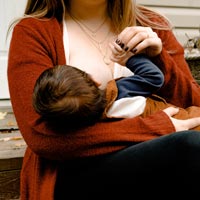
 Breast milk is nature’s totally natural food for newborns and little ones, containing nothing artificial or added.
 Babies are also more protected against asthma if they have been breastfed.
 Breastfeeding a baby reduces the chance of mothers developing Type 2 Diabetes.
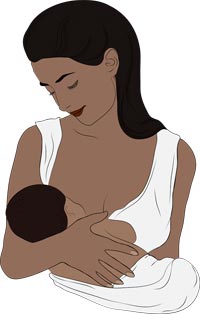 Our top 25 benefits of breastfeeding really only scratch the surface. Breastfeeding and breast milk have many more benefits including anything from saving money and being more convenient (nothing needs buying or preparing) to being better for the planet. With breast milk, there’s no packaging to throw away and it’s a totally sustainable food source, direct from nature. Incredible when you think about it.
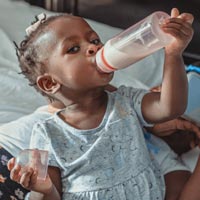 Last month, we mentioned what a huge topic formula milk is. So, in this post, we thought we’d explore all the different types of milk available to infants in the UK.
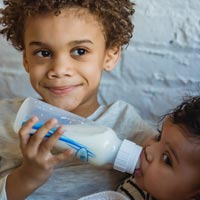 Baby and infant formula milk comes ready-made in liquid form or as a powder that needs to be carefully and hygienically made up. The liquid variety is usually the more expensive of the two and needs to be used sooner, due to its shorter shelf life. Whichever is used, labels should be carefully checked to ensure suitability for the age of the particular baby/infant in question.
 Comfort Formula is another type of formula milk based on cows’ milk, but the milk proteins it contains are already partially broken down (partially hydrolysed). It is marketed as being easier for the infant to digest and, as such, a formula milk that will reduce the chance of constipation or colic. However, there is no evidence to back up such claims. It’s suitable from birth but parents should ask for advice from their Health Visitor or midwife before giving their baby this type of milk, and certainly not use it if their infant is allergic to cows’ milk.
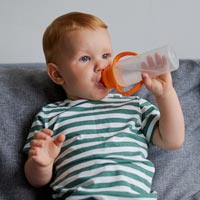 From the age of 1: your baby can move onto drinking whole pasteurised cows’ milk as their main drink (or alternatively sheeps’ or goats’ milk so long as it’s also pasteurised) as part of a healthy, balanced diet. It should not be given to children before they’re one because it does not contain enough iron.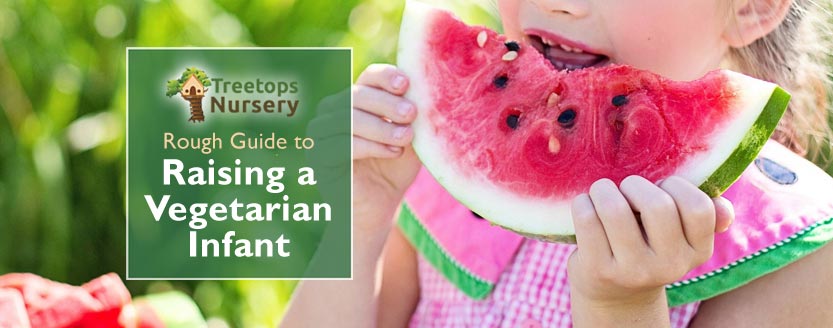
 More and more parents are bringing up youngsters as vegetarians these days, so we thought we’d put together a rough guide to raising babies, toddlers and preschoolers as vegetarians. When doing so, certain considerations will need to be made, including ensuring that meals are nutritious, containing all the necessary food groups, vitamins and minerals needed by the very young.
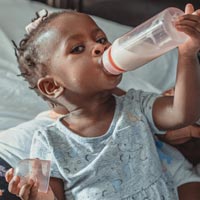 The good news is that formula milk that’s suitable for vegetarians is available. Parents may ask their midwife or health professional for any recommendations in regard to types or brands, particularly if one formula milk disagrees with the baby. However, whichever brand and type is chosen, the formula milk must be formulated for the baby’s specific age. This is usually obvious on the product label.
 From around the age of 6 months, your baby will usually start the process of weaning off of milk and begin to eat solid foods, albeit given in puréed or liquidised form initially. This is when parents then need to be mindful of their child’s nutritional needs and this is even more pertinent when bringing up a child as a vegetarian.
 Well, tofu and other soya products will contain good quantities of protein.
 Iron is essential for growing children and can be found in many of the foods mentioned above. That said, it’s worth mentioning that some foods block the absorption of iron. Such foods include tea as well as whole grains and legumes containing ‘phytates’, dairy products containing ‘casein’ and eggs and dairy products that contain particular forms of calcium. The simple solution to many of these is as follows:
 Of course, that can be the case. What’s more, such handheld screens are a great way for parents to keep children entertained when perhaps they need to get on with other things. Electronic handheld devices also teach children about technology and introduce them to IT; essential skills for them to master in this day and age. Even games can be educational, with some designed to improve children’s numeracy etc. while at the same time being enormous fun. The key, though, is for parents to ensure that children are looking at the right content and not for extended periods of time. Ideally, it should be content that’s informative — i.e. content that will teach them something new, introduce them to new topics and allow them to make discoveries that will educate them. So, the content needs to be chosen and curated by parents — not the child.
 There are some tools available to help parents accomplish this. While we don’t endorse any particular online safety application over any other, applications like
  Hundreds of scientist and medical professionals around the world are convinced that handheld devices like mobile phones and tablets are potentially harmful to humans, especially unborn children, when connected to Wi-Fi. They say that this is due to the ‘RF wireless radiation’ that the devices emit when connected to the web (etc.). What’s more, they appear to have some compelling science and research to back up their claims.
 Parents, guardians or carers should start brushing children’s teeth the moment teeth first appear, even when it’s only one or two teeth initially showing through. This is typically around the age of six to ten months when, for most babies, the lower incisors are first to appear. It varies enormously, though, with some babies even being born with one or more teeth. For teething babies, of course, you need to be more gentle with brushing than you would be for an older child, because their gums will probably be sore. Hence, there are some guidelines to follow in that regard. That’s exactly where this article comes in as we explain the accepted best practice for brushing infant teeth.
 The same general approach can be used for children aged 3 or over, except toddlers may stand, so long as their head can still rest against you so that it’s kept stable and relatively still while brushing takes place. As mentioned in the preceding section, a pea-sized amount of toothpaste can be used for this age group.
 As well as regular brushing of teeth and dentist check-ups, there are many additional measures that can protect children’s teeth. These really all come down to one thing; avoiding added sugar. So …
 The more obvious additional health and safety concerns include the following:
 This guide was brought to you by the childcare team at


 In this, the first of two new posts relating to the very youngest of children, we’re looking at teething, including when it usually happens and what to do about it as a parent or carer. Teething can be stressful for parents and a painful time for babies, so it’s important to read the signs correctly and act accordingly.
 Most babies are born with no teeth showing at all. However, there are exceptions and it’s reasonably common to be born with one or more milk teeth already visible. In total, babies will have a total of 20 milk teeth; 10 in the upper jaw and 10 in the lower. These are already there at birth as they will have grown during the embryonic stage. However, they are hidden within the gums in most cases.
 Teething can cause babies pain and discomfort during the 8 days in which each tooth moves from under the gum to erupting through it. Apart from the obvious signs of the tooth erupting and perhaps a bluey-grey eruption cyst colouration in the gums, symptoms of teething include:
 There are a number of ways parents and carers can help babies and toddlers through their teething. One or more of the following may help:
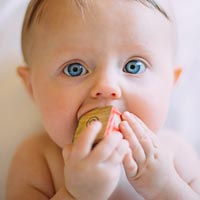 According to the NHS, there is no evidence that commercially-available teething gels (including homeopathic ones) are effective, so they recommend that non-medical options like those above should be tried first.
 When the time is right (usually by the age of 6) the milk teeth will start to shed. Normally, this is done in a particular order: first the two lower front teeth and the two upper front teeth will fall out (these are called the central incisors). Next to fall are the lateral incisors, then the first molars, the canines and finally the second molars.

 Less likelihood of developing cardiovascular disease including hyperlipidemia1;
 Higher physical activity and physical fitness levels are associated with improved cognitive performance (e.g., concentration, memory) among students.3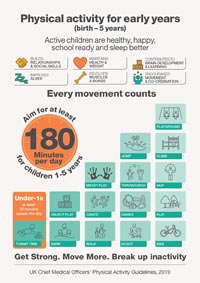
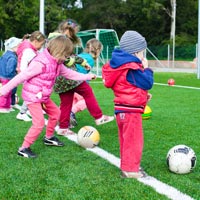 Knowing how important it is, we take exercise very seriously at Treetops Nursery in Willesden. However, we ensure that it’s always fun and exciting, so that children enjoy it, naturally. Physical movement and active play are all part of
 If you are living in England and are bringing up one or more children there, you are usually eligible to receive Child Benefit. This is a payment made by the Government to help with the costs associated with bringing up children. It’s made to those responsible for bringing up children up to 16 or, if they’re still in approved education or training, 20 years of age. This guide will go through the key facts around what you’re entitled to and eligibility.
 Additional Benefits of Child Benefit
 Reasons You May Not Be Eligible
 Childcare in Willesden, near Willesden Green, Harlesden & Kensal Green, NW10