
 Many new parents ask themselves whether they should send their baby, toddler or under-five child to nursery/pre-school. What exactly are the benefits to the child? Well, studies have shown that there are clear benefits for children if they attend a good nursery or pre-school in their early years. That good aspect is crucial, though, and as a good nursery ourselves (that’s official), we strongly agree. The benefits are obvious to us, but you don’t need to take our word for it. Today, we’ll look at the findings of independent research, including a recent study by the Department for Education (‘DfE’), demonstrating the clear benefits of sending children to a good nursery and/or pre-school during their early years.
What is a Good Nursery?
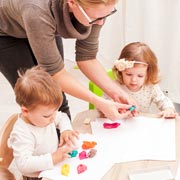 First, though, let’s clarify what makes a good nursery superior to a mediocre one. To give just a few examples, a good nursery will educate children under their care — they don’t simply babysit them because parents are at work. They’ll nurture children’s wellbeing, their learning and their development. They’ll create a learning and development programme that’s tailored to the strengths, weaknesses and interests of each individual child. A good nursery will set personal goals and continually assess the child’s progress, actually in partnership with parents. They’ll help every child to achieve personal bests in every area of a good Early Years curriculum. They’ll also do everything they can to help each child become school-ready by the time they leave, so they can move on seamlessly to Reception Year at primary school. Along the way, a good nursery, like Treetops, will help children in a huge number of ways, becoming more able, more self-confident, more independent, well-mannered, knowledgeable, aware of what’s right and wrong, able to socialise with others in an appropriate way — and so much more.
The Benefits of a Good Nursery or Pre-school
Now we’ve established what a good nursery/pre-school is, what did the 2020 DfE study say about sending under-fives to one? Well, they found that there are both short-term and long-term benefits to children if they attend a good nursery/pre-school during their early years.
Early childhood education benefits the educational, cognitive, behavioural and social outcomes of children in both the short and long term.
(Finding of the DfE study, February 2020).
 When a child gets a good educational grounding during their early years, their behaviour around others is also seen to improve, with better self-regulation, less problems with peers and fewer emotional issues. A 2002 study (Sammons et al.) found that the benefits could be seen from as young as two.
What’s more, a 2011 study from the OECD found that, by the time they reached the age of 15, children who had received a good early years education were outperforming other students by the equivalent of a year. That’s amazing when you think about it.
Looking further ahead, a 2018 study (Sim) found that a decent early years education, in good nurseries, pre-schools and childcare settings, boosted self-confidence and social skills in such a way as to provide “a better foundation for success at school, and subsequently in the workplace.”
“a better foundation for success at school, and subsequently in the workplace.”
Those are far-reaching outcomes! In effect, they’re saying that children’s lives will be positively impacted right into adulthood, simply because they attended a good early years education setting — just like that available at Treetops Nursery in Willesden.
Special Benefits for Disadvantaged Children
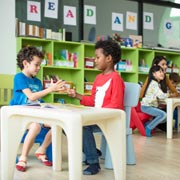 The most far-reaching benefits of a good early years education were found to be for children from disadvantaged backgrounds. The 2020 impact study by the DfE found the following:
- Children in this category benefit most if they attend a good early years education setting for at least 10 hours a week by the time they’re 2.
- Similarly, 3 and 4-year-olds from disadvantaged backgrounds benefit most if they attend for at least 20 hours per week.
- The results from this are improved verbal abilities and attaining goals expected of their age once they begin school in Reception year.
- Indeed, those children from backgrounds with particularly poor home learning environments had a marked increase in verbal ability once they moved on to school.
- So, a kind of levelling-up is provided by decent early years education.
It’s clear that the carefully structured curriculum and approach to learning and development at good early years settings really does help children to be better prepared and able for school at the age of five. This head-start, in turn, helps them to achieve more at school and later in the workplace, with better job prospects, all leading to better lifelong outcomes overall. There is even a link to reduced involvement in crime. These are incredibly important findings.
 Benefits for Families & the Nation
As well as benefiting children, there are clear benefits to family households too, of course. Without getting too deeply into that in this particular article, obvious benefits include allowing parents/carers to get back to their careers after pausing for parental leave, allowing income levels to be healthier and upward mobility more likely. Overall, good childcare means less poverty and dependency on welfare too, along with lower crime levels.
A Good Nursery in Willesden, near Harlesden, Kensal Green & Willesden Green
 If you’d like a really solid foundation for your child’s future, then consider childcare at a good nursery like Treetops Nursery in Willesden, London NW10. We offer the highest quality weekday childcare for babies and children aged up to five. Our Willesden nursery and pre-school is near Willesden Green, Harlesden, Kensal Green and those in the NW2 & NW6 postcodes. We also support Government-funded childcare for 2, 3 and 4-year-olds (where eligible).
To register your interest in a nursery place for your child, please get in touch. We’ll be happy to hear from you and can’t wait to show you around and to tell you more …

 Today, we look at another condition that can affect children: dyscalculia. This is a brain-related learning difficulty that affects both children and adults. Somewhere between 3 and 6 percent of the UK population is affected and some may also have other conditions like
  The Diagnostic & Statistical Manual of Mental Disorders (DSM-5), as used by psychiatric professionals in the U.S., describes how those with developmental dyscalculia have problems making sense of numbers, memorising arithmetic facts and making fluent and accurate maths calculations. Clearly, such limitations can have a profound effect, including in terms of education because maths affects so many learning topics.
 They may be more prone to continue using their fingers to count, long after their peers have moved onto mental arithmetic.
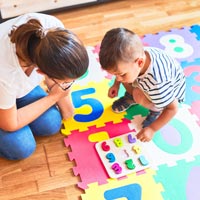 Also, of course, speak to the childcare and teaching professionals at your childcare nursery, pre-school, school or education setting. Just like staff at Treetops Nursery, they will be able to offer some support and also keep an eye out for possible signs. It’s always important for parents and childcare/teaching professionals to be in close contact anyway. In this way, we can all have the same goals in mind, share the same learning and development plans and keep each other informed as each child progresses on their learning journey.
 Use of lined or graph paper can sometimes help too, so as to keep corresponding numbers in line and steps more clear.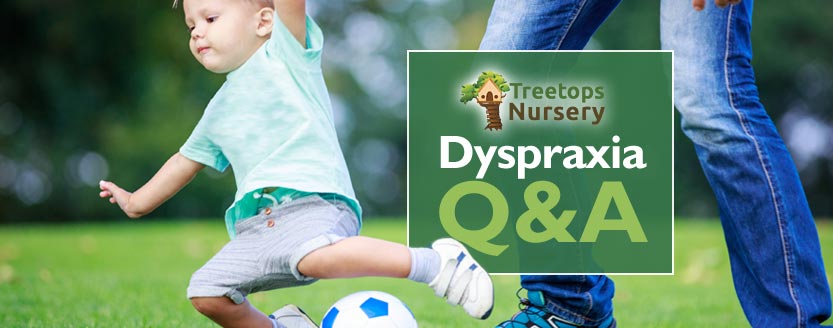
 A: Dyspraxia is a condition that impairs a person’s ability to fully control motor functions, for example coordinating movement and physical activity. Children with dyspraxia may therefore appear ‘clumsy’. It can be anything from mild to more severe and obviously the mildest variety is hardest for parents to spot. Dyspraxia is classified as a type of Developmental Co-ordination Disorder (‘DCD’) and indeed healthcare professionals may use this terminology for the condition. They may also refer to it as a Specific Developmental Disorder of Motor Function, or ‘SDDMF’ for short.
 A: Dyspraxia can be something people were simply born with (that’s the developmental kind) or, for others, it was acquired through brain trauma, for example because of an injury or stroke. In this post, however, we’ll concentrate on developmental dyspraxia in relation to children.
 Children with dyspraxia may also have difficulty:
 A: Due to its nature and particularly in regard to its negative effect on sports and active play skills, dyspraxia can lead to children becoming less naturally fit, with all the ramifications that brings.
 A: Once diagnosed, tailored help is available for children with dyspraxia/DCD, from a variety of specialists. Support may be needed throughout childhood, including at pre-school and school, to help optimise ability around physical tasks and processes. As every child’s challenges will be unique, a support plan will be customised for each. Support may involve a variety of professionals who will aim to help the child overcome their difficulties as far as possible and to build their confidence, self-esteem, abilities etc. The specialists involved may include paediatric occupational therapists, paediatricians, clinical psychologists, educational psychologists or a mixture of several. All will work in tandem, of course, with childcare professionals, teachers, parents and guardians.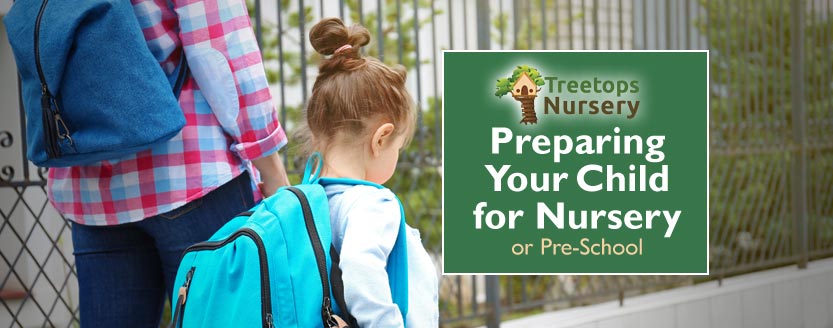
 Going from living a life at home with the family to suddenly being thrust into a new environment full of strangers would be daunting enough for anyone. It’s especially true, though, for under-fives starting at nursery or pre-school. So, the key is to prepare children for the change and, of course, for the nursery/pre-school to be very welcoming and accommodating. Here, we’ll take a look at some of the things that will help toddlers and preschoolers transition as smoothly as possible.
 Once you’ve selected
  Helping toddlers with toilet training, personal hygiene, speaking, communicating, following rules, tidying up after themselves, hanging up their coat, fastening shoes, packing their backpack and suchlike will also help them with their self-confidence once they start nursery. If they are a little more independent and able when they start, they will naturally also be a little more self-confident and relaxed at the new setting.
 Our childcare professionals have many years of childcare experience, so helping children settle in is second nature to us. Rest assured, we will ensure that your child has fun, feels relaxed and is safe at all times. We will ensure that this milestone in their lives goes as smoothly as possible and that their time at the nursery/pre-school is a resounding success.









 Willesden and other north-west London areas close by feature regularly in the long-running BBC mystery crime drama Jonathan Creek. This popular series stars actor and comedian Alan Davies as the main protagonist. Other occasional stars who appeared in the series included Griff Rhys Jones, Rik Mayall, Jack Dee (who we’ll hear more about below), Bill Bailey, Nigel Planer and even Bob Monkhouse.
 Actor and dead-pan comedian Jack Dee co-wrote and starred in ‘Lead Balloon’, a BBC4 comedy series that first ran on British TV from 2006 to 2011. The first episode actually achieved the highest ever ratings for a comedy on the channel at the time and the series later aired on BBC2 and to audiences on BBC HD. There were three series in total, with the first two being filmed in and around Willesden. Indeed, the main characters Rick (played by Jack Dee) and his partner Mel (played by Raquel Cassidy) live in a house located in Willesden. A café called ‘Michael’s Café’ in series one and two is, in reality, ‘Gracelands Café’, which is located just a stone’s throw from Willesden in Kensal Green.
 Willesden also features in the British TV comedy-drama ‘Minder’ that was extremely popular on ITV/Thames Television from late 1979 through to the mid-90s. One of the two key protagonists, Arthur Daley (played by George Cole), kept a lock-up garage in Willesden and this is where he kept all his merchandise. He also did many of his deals in and around the area. One episode of Minder was even called ‘Willesden Suite’. No less than 10 series aired in total, making George Cole and Dennis Waterman into household names.
 ‘The Last Detective’ was another extremely popular British TV drama that ran for 4 series between 2003 and 2007. The main protagonist was ‘Dangerous Davies’, a Detective Constable played by Peter Davison. ‘Dangerous Davies’ was, in fact, the series of books upon which the TV drama was based. Filming of episodes often took place in Willesden, Harlesden and other parts of north/north-west London. Indeed, episode 4 (s.3) was called ‘Willesden Confidential’ and episode 3 (s.4) was called ‘A Funny Thing Happened on the Way to Willesden’.
 Zomba was widely accepted to be the most successful independent music company (The Zomba Music Corporation sold for literally billions eventually). Along the way, Zomba bought legendary music company Rough Trade and itself eventually became owned by BMG, then later Sony Music Entertainment under the RCA/Jive Label Group umbrella and later still its artists moved across to Epic Records. One of the original founders of Zomba is a certain Mutt Lange, who became a legendary producer (later marrying Shania Twain) who has worked with Def Leppard, The Boomtown Rats, Huey Lewis and the News, Britney Spears, Nickelback, Maroon 5, Bryan Adams, Celine Dion, The Corrs, Billy Ocean, Lady Gaga, Muse, AC/DC, Foreigner, Tina Turner, Backstreet Boys, The Cars and many more. Music genres cover everything from rap and hip-hop to pop and rock. From humble beginnings, this Willesden company influenced music and culture around the entire world.
 ‘Morgan Studios’ was another very influential and successful music company that started life in Willesden, pre-dating Zomba, back in the 1960s. They went on to work with huge names like Free, Blind Faith, Led Zeppelin, Supertramp, Paul McCartney, Wings, Rod Stewart, Yes, Black Sabbath, Jethro Tull, Cat Stevens, Pink Floyd, Carly Simon, Alice Cooper, Lou Reed, The Who, The Jam, The Cure, The Stone Roses, Thin Lizzy, The Kinks (more about them below), Squeeze, Gary Moore, Peter Gabriel, Bonnie Tyler, Elton John, and many more household names. The recording studios were based at 169-171 High Road, Willesden, being owned originally by Barry Morgan, the drummer in successful bands like ‘Blue Mink’ and others. Interestingly, in 1980, Morgan Studios were sold half to Zomba (see above) and half to Robin Millar CBE who, four years later, produced the seminal album ‘Diamond Life’ by Sade. He is also a legendary music executive, who worked with many other huge names including Eric Clapton, Sting, Herbie Hancock, Elvis Costello, Bruce Hornsby, Malcolm McLaren and Alison Moyet to name just a few.