Bird Feeder Activity for Kids
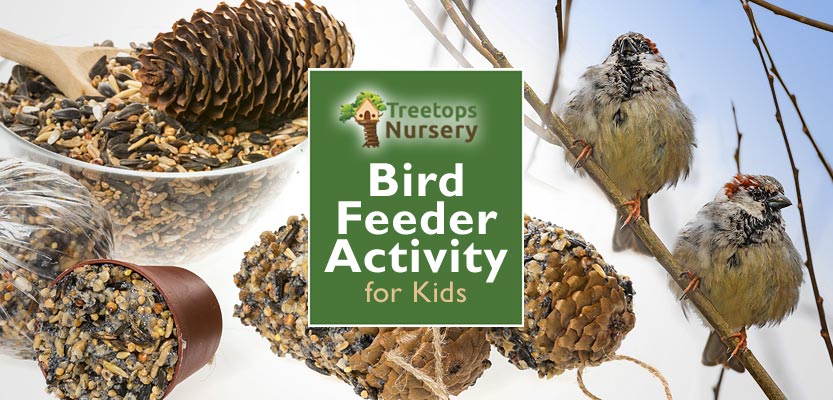
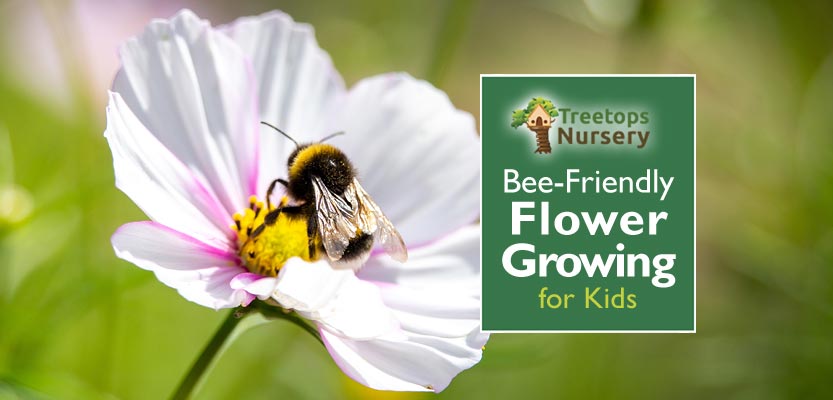
 As promised in our recent posts ‘How to Attract Garden Wildlife – for Under-5s’ and ‘Bee-Friendly Flower Growing for Kids’, we follow up today with a guide to bird feeders that children can enjoy making at home. It’s a creative and educational activity that children of all ages will enjoy. And, With the right location and bird food, the home-made bird feeders are sure to attract a multitude of beautiful birds to the garden for the children to enjoy and learn from.
With any of these feeders, though, don’t expect birds to come right away. They’ll be suspicious of anything new in the garden for a while, so children need to be patient while the birds learn to trust the new addition. Once they have accepted it, though, they’ll come again and again if suitable food continues to be supplied.
Apple Feeders
 Starting with the most simple bird feeder of all, children can make an apple bird feeder. All they need is an apple and something to hold it. So, a piece of string threaded through it would be one easy solution for a hanging apple feeder (an adult may need to supervise for safety reasons). Another would be to spear the apple onto a vertical stick (see example photo), bamboo cane or even a suitably angled tree branch/twig. Again, adult supervision would be wise so the child does not hurt itself. Try peeling off some of the skin to show the apple flesh and this may encourage birds to have a peck. Apple feeders may be particularly popular with blackbirds.
Pine Cone Feeders
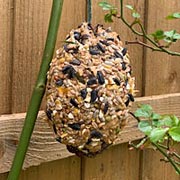 These are easy and fun for children to make. All they need is a suitable pine cone that’s ‘opened’, some bird seed and either peanut butter, suet or lard.* Children simply need to paste the peanut butter, suet or lard into the spaces between the pine cone scales, then roll the entire thing in bird seed, which will stick, and suspend the new feeder by string. Easy!
If no pine cone is available, the same approach can be used but using a chunk or thick slice of bread instead of the pine cone. However, we do not recommend it as bread will go mouldy if left outside for more than a day or two, and this can harm or even kill birds.
Suet* Flower Pot Seed Cakes
Suet or lard can also be used to make flower pot seed cakes. However, this will require the help of an adult because it will need to be …
 Today, we follow up last month’s
  Parents/guardians of under-fives will need to supervise which seeds to buy — or to harvest free of charge at the end of a previous season. If purchased, they’re inexpensive with seed packets typically costing as little as £1.99 from places like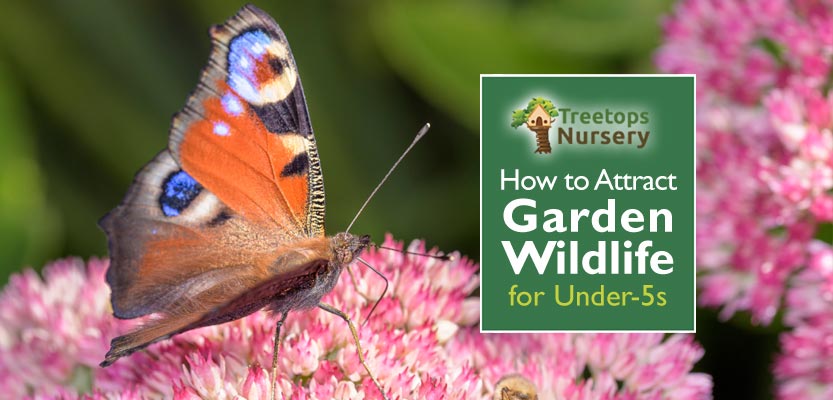
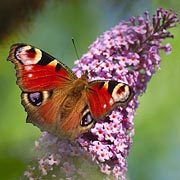 The little creatures that nature provides are some of the most wonderful, magical things that both fascinate and educate young children. Nature is a wondrous thing, when you think about it. All the little beings and characters that crawl or dart around any wildlife-friendly garden will enrich both the garden and any onlooker. What’s more exposure to
 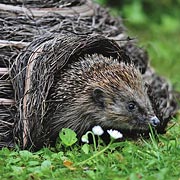 Hedgehogs also love piles of leaves, so long as they’re left undisturbed and are somewhere peaceful and safe. Therefore, a pile of them under a secluded bush or underneath a shed may prove popular with them. Children can also make hedgehog hotels — or buy commercially available ones from a garden nursery or online. It’s essential that hedgehogs are able to get into the garden in the first place, though. Therefore, there needs to be a space somewhere to get in, e.g. under a garden gate and/or under one or more parts of the fence around the garden. If there are no gaps, then there is no point in putting out a hedgehog hotel.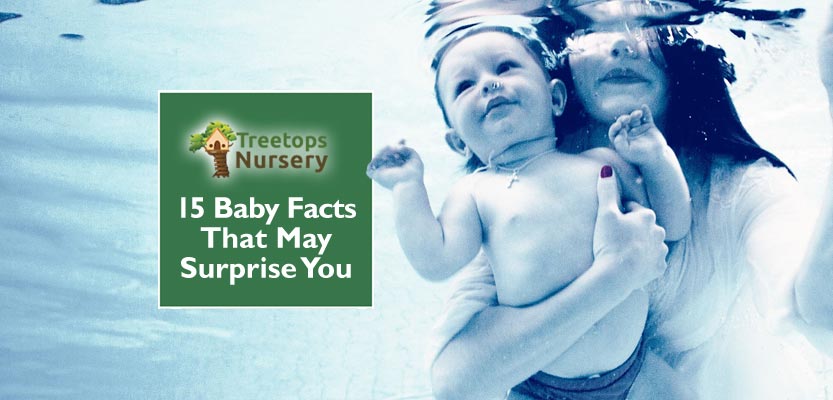
 Today we take a look at some amazing baby facts, many of which may come as a surprise. Human babies are incredible in so many ways, but you may not be aware of just how incredible they really are …
 Studies suggest that more babies are born in September than in any other month. In fact, the top four birth days are all in September with 9th September seeing the most babies born, followed in order by 19th, 12th and 17th September. With September being the first term of the year in the UK, it may come as no surprise that those September babies, being the oldest in the class, tend to be the smartest in their peer groups.
 Humans are just one species within a group of 200 primates that includes monkeys, apes and lemurs. Did you know, however, that baby humans are the only primate babies that smile at their parents? That’s unless other primates use some other way of smiling that’s unknown to us, of course — it’s possible!
 Are you a parent who wants to continue studying in higher education, but may struggle to afford childcare costs? If so, we have some great news for you. Student Finance England offers eligible students, who are also parents, a generous grant for their child’s childcare. This may allow them to continue with higher education in the knowledge that their child is being looked after by childcare professionals while they study. It can make a real difference, allowing parents to concentrate on studying and potentially increase household income once they graduate their courses.
 To be eligible, the following rules apply:
 At the time of writing, spring is just around the corner and snowdrops and daffodils are already sprouting out of the ground. Soon, it’ll start to feel warmer and we’ll be more likely to venture outdoors again. With that in mind, we thought the time was perfect for a post all about the benefits of nature to children, particularly in their early years. If you’re a parent/carer and your children don’t usually get much exposure to nature, take a look at these benefits and consider encouraging them to get out more. The natural world and everything it offers will enrich their young lives in a myriad of natural ways.
 Nature is good for both mind & spirit. Many studies have shown that time spent with nature is very healthy for mental wellbeing and you only have to spend time in the Great Outdoors to know that this is true. There is something instinctively calming about spending time outdoors, surrounded by flora and fauna, and this is very beneficial for mental health, including relieving stress, anxiety and even depression.
 Spending time in the natural environment, surrounded by nature and everything that it brings, allows children to get a better perspective on life. Once they see the enormity of the ‘bigger picture’, small issues they may be facing will become insignificant and they will learn what’s really important and what’s not.
 Treetops Nursery adheres to the Early Years Foundation Stage (‘EYFS’) framework. This is a structured approach to learning and development for under-fives and is prescribed, by the UK Government, for childcare settings such as ours. It covers 7 key areas of focus for learning and development, which are explained concisely on
 Many new parents ask themselves whether they should send their baby, toddler or under-five child to nursery/pre-school. What exactly are the benefits to the child? Well, studies have shown that there are clear benefits for children if they attend a good nursery or pre-school in their early years. That good aspect is crucial, though, and as a good nursery ourselves (
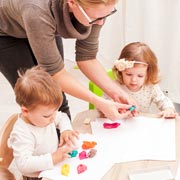 First, though, let’s clarify what makes a good nursery superior to a mediocre one. To give just a few examples, a good nursery will educate children under their care — they don’t simply babysit them because parents are at work. They’ll nurture children’s wellbeing, their learning and their development. They’ll create a learning and development programme that’s tailored to the strengths, weaknesses and interests of each individual child. A good nursery will set personal goals and continually assess the child’s progress, actually in partnership with parents. They’ll help every child to achieve personal bests in every area of a good Early Years curriculum. They’ll also do everything they can to help each child become school-ready by the time they leave, so they can move on seamlessly to Reception Year at primary school. Along the way, a good nursery, like Treetops, will help children in a huge number of ways, becoming more able, more self-confident, more independent, well-mannered, knowledgeable, aware of what’s right and wrong, able to socialise with others in an appropriate way — and so much more.
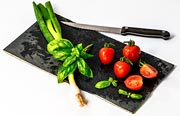 Did you know that you can grow vegetables, salads and herbs at home, almost free of cost? You don’t need seeds and you don’t even need a garden! Today we’ll explain how you and your child can help the household with an almost endless supply of potentially free, home-grown fresh produce, all year round. Children will have enormous fun with this amazing activity, whilst learning new skills and gaining important knowledge along the way. Even better — you all get to eat the produce once the home-grown ‘crops’ are ready! And it should save money for the household.
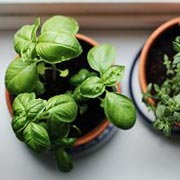 One of the many beauties of this activity is that you don’t need to buy any seeds or plants specifically for the task. You are going to show your child how to regrow small off-cuts of vegetables and herbs that you would already have bought as part of your weekly shop. To explain, some of the parts that you’d normally discard can actually be used to grow new vegetables — lettuce, for example. And, for herbs, there’s an easy and free way to grow new plants from small cuttings of shop-bought herbs that you may have purchased anyway (basil or parsley, for example). Using this approach, you could grow your own vegetables, salads and herbs and, in theory, never have to buy any again! We’ll explain later, in more detail. First, we’ll look at what you and your child will need for your plants to grow in.
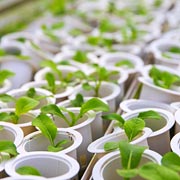 If your household already has flower pots or seed trays, then great. If not, there’s not even any need to buy them if you simply recycle things like empty egg cartons, used yoghurt pots, margarine tubs, the plastic trays from ready meals and suchlike. So long as they’ll hold some earth/compost and some holes are pierced in the bottom for drainage (this is best if done by an adult, for safety), then you’re almost good to go.
 Today, we look at another condition that can affect children: dyscalculia. This is a brain-related learning difficulty that affects both children and adults. Somewhere between 3 and 6 percent of the UK population is affected and some may also have other conditions like
  The Diagnostic & Statistical Manual of Mental Disorders (DSM-5), as used by psychiatric professionals in the U.S., describes how those with developmental dyscalculia have problems making sense of numbers, memorising arithmetic facts and making fluent and accurate maths calculations. Clearly, such limitations can have a profound effect, including in terms of education because maths affects so many learning topics.