When it comes to breastfeeding vs. formula milk, there’s a good reason why the phrase ‘Breast is Best’ holds true. In fact, there are many benefits to breastfeeding including several for both baby and mother. Here are our top twenty-five:
15+ Breastfeeding Benefits for Babies
 Breast milk is nature’s totally natural food for newborns and little ones, containing nothing artificial or added.
- It’s tailored perfectly to the needs of the growing infant, adapting to their needs as they grow.
- It passes on antibodies straight to the newborn baby.
- It contains everything the baby needs for healthy development, including all the right proteins, vitamins, fats and even hormones.
- Breast milk also contains long-chain polyunsaturated fatty acids, which are essential for the baby’s developing brain.
- Data suggests that at least 6 months of breastfeeding protects against the possible development of childhood leukaemia.
- It’s also likely to protect against the development of Sudden Infant Death Syndrome (‘SADS’).
- Premature babies are also more protected against the bowel disorder Necrotising Enterocolitis (‘NEC’), which can be potentially serious.
 Babies are also more protected against asthma if they have been breastfed.
- Breast milk protects children against allergic rhinitis.
- Children are less likely to suffer from severe eczema, wheezing and respiratory infections if they were breastfed as babies.
- Children who were breastfed as babies are also statistically less likely to suffer from ear infections.
- Evidence also suggests that continuing with some breast milk once a child starts weaning onto solids (usually around the age of 6 months) may protect them against the development of some food allergies.
- Breastfed babies are also less likely to develop gastrointestinal infections and diarrhoea.
- Many of the benefits of breastfeeding during early childhood actually continue to benefit the individual once they’re adults, which is remarkable.
10+ Breastfeeding Benefits for Mums
 Breastfeeding a baby reduces the chance of mothers developing Type 2 Diabetes.
- Mothers who breastfeed are less likely to develop breast cancer.
- They’re also less likely to develop ovarian cancer.
- They’re less likely to develop osteoporosis.
- Breastfeeding mums are also less likely to develop cardiovascular disease.
- Their weight is also more likely to return to its normal level following pregnancy if they breastfeed.
- Breastfeeding a baby reduces the chance of mothers becoming obese.
- The uterus of mothers who breastfeed also returns to its normal size far sooner.
- Periods return later in mums who breastfeed, which could help with family planning.
- Last but not least, breastfeeding allows closer bonds to quickly form between baby and mother.
 Our top 25 benefits of breastfeeding really only scratch the surface. Breastfeeding and breast milk have many more benefits including anything from saving money and being more convenient (nothing needs buying or preparing) to being better for the planet. With breast milk, there’s no packaging to throw away and it’s a totally sustainable food source, direct from nature. Incredible when you think about it.
Milk at Treetops Nursery, Willesden
Parents/guardians of babies and children at Treetops Nursery are welcome to supply their own preferred milk, whether that’s bottled breast milk or specific types of formula milk. If supplying the latter, there’s no need to make it up as we can prepare it for your child, so that it’s more freshly prepared and the right temperature etc. Please do label your child’s milk/bottles/etc. with your child’s name, though. It’s also best to supply them in a cool bag, please, also clearly labelled. Nursing mums who wish to breastfeed their child at the nursery are also offered an appropriate, private space in which to do so.
Our Outstanding Nursery in Willesden, near Harlesden & Kensal Green
 Are you looking for the best nursery for your child? If so, you’ll find Treetops Nursery very hard to beat. Our nursery is in Willesden, so is near to Willesden Green, Kensal Green and Harlesden in London NW10. It’s suitable for babies, toddlers and children aged up to five. Fees are competitive, facilities and equipment are excellent and we received a glowing report from Ofsted. If you’re potentially interested in a nursery place for your baby or child while some are still available, please get in touch. We’ll be happy answer questions and show you/your child around too. Please select from the following as preferred:
 Last month, we mentioned what a huge topic formula milk is. So, in this post, we thought we’d explore all the different types of milk available to infants in the UK.
 Baby and infant formula milk comes ready-made in liquid form or as a powder that needs to be carefully and hygienically made up. The liquid variety is usually the more expensive of the two and needs to be used sooner, due to its shorter shelf life. Whichever is used, labels should be carefully checked to ensure suitability for the age of the particular baby/infant in question.
 Comfort Formula is another type of formula milk based on cows’ milk, but the milk proteins it contains are already partially broken down (partially hydrolysed). It is marketed as being easier for the infant to digest and, as such, a formula milk that will reduce the chance of constipation or colic. However, there is no evidence to back up such claims. It’s suitable from birth but parents should ask for advice from their Health Visitor or midwife before giving their baby this type of milk, and certainly not use it if their infant is allergic to cows’ milk.
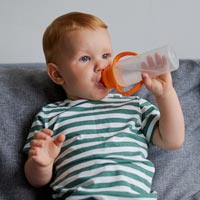 From the age of 1: your baby can move onto drinking whole pasteurised cows’ milk as their main drink (or alternatively sheeps’ or goats’ milk so long as it’s also pasteurised) as part of a healthy, balanced diet. It should not be given to children before they’re one because it does not contain enough iron.
 More and more parents are bringing up youngsters as vegetarians these days, so we thought we’d put together a rough guide to raising babies, toddlers and preschoolers as vegetarians. When doing so, certain considerations will need to be made, including ensuring that meals are nutritious, containing all the necessary food groups, vitamins and minerals needed by the very young.
 The good news is that formula milk that’s suitable for vegetarians is available. Parents may ask their midwife or health professional for any recommendations in regard to types or brands, particularly if one formula milk disagrees with the baby. However, whichever brand and type is chosen, the formula milk must be formulated for the baby’s specific age. This is usually obvious on the product label.
 From around the age of 6 months, your baby will usually start the process of weaning off of milk and begin to eat solid foods, albeit given in puréed or liquidised form initially. This is when parents then need to be mindful of their child’s nutritional needs and this is even more pertinent when bringing up a child as a vegetarian.
 Well, tofu and other soya products will contain good quantities of protein.
 Iron is essential for growing children and can be found in many of the foods mentioned above. That said, it’s worth mentioning that some foods block the absorption of iron. Such foods include tea as well as whole grains and legumes containing ‘phytates’, dairy products containing ‘casein’ and eggs and dairy products that contain particular forms of calcium. The simple solution to many of these is as follows:
 Of course, that can be the case. What’s more, such handheld screens are a great way for parents to keep children entertained when perhaps they need to get on with other things. Electronic handheld devices also teach children about technology and introduce them to IT; essential skills for them to master in this day and age. Even games can be educational, with some designed to improve children’s numeracy etc. while at the same time being enormous fun. The key, though, is for parents to ensure that children are looking at the right content and not for extended periods of time. Ideally, it should be content that’s informative — i.e. content that will teach them something new, introduce them to new topics and allow them to make discoveries that will educate them. So, the content needs to be chosen and curated by parents — not the child.
 There are some tools available to help parents accomplish this. While we don’t endorse any particular online safety application over any other, applications like
  Hundreds of scientist and medical professionals around the world are convinced that handheld devices like mobile phones and tablets are potentially harmful to humans, especially unborn children, when connected to Wi-Fi. They say that this is due to the ‘RF wireless radiation’ that the devices emit when connected to the web (etc.). What’s more, they appear to have some compelling science and research to back up their claims.
 Parents, guardians or carers should start brushing children’s teeth the moment teeth first appear, even when it’s only one or two teeth initially showing through. This is typically around the age of six to ten months when, for most babies, the lower incisors are first to appear. It varies enormously, though, with some babies even being born with one or more teeth. For teething babies, of course, you need to be more gentle with brushing than you would be for an older child, because their gums will probably be sore. Hence, there are some guidelines to follow in that regard. That’s exactly where this article comes in as we explain the accepted best practice for brushing infant teeth.
 The same general approach can be used for children aged 3 or over, except toddlers may stand, so long as their head can still rest against you so that it’s kept stable and relatively still while brushing takes place. As mentioned in the preceding section, a pea-sized amount of toothpaste can be used for this age group.
 As well as regular brushing of teeth and dentist check-ups, there are many additional measures that can protect children’s teeth. These really all come down to one thing; avoiding added sugar. So …
 The more obvious additional health and safety concerns include the following:
 This guide was brought to you by the childcare team at
 In this, the first of two new posts relating to the very youngest of children, we’re looking at teething, including when it usually happens and what to do about it as a parent or carer. Teething can be stressful for parents and a painful time for babies, so it’s important to read the signs correctly and act accordingly.
 Most babies are born with no teeth showing at all. However, there are exceptions and it’s reasonably common to be born with one or more milk teeth already visible. In total, babies will have a total of 20 milk teeth; 10 in the upper jaw and 10 in the lower. These are already there at birth as they will have grown during the embryonic stage. However, they are hidden within the gums in most cases.
 Teething can cause babies pain and discomfort during the 8 days in which each tooth moves from under the gum to erupting through it. Apart from the obvious signs of the tooth erupting and perhaps a bluey-grey eruption cyst colouration in the gums, symptoms of teething include:
 There are a number of ways parents and carers can help babies and toddlers through their teething. One or more of the following may help:
 According to the NHS, there is no evidence that commercially-available teething gels (including homeopathic ones) are effective, so they recommend that non-medical options like those above should be tried first.
 When the time is right (usually by the age of 6) the milk teeth will start to shed. Normally, this is done in a particular order: first the two lower front teeth and the two upper front teeth will fall out (these are called the central incisors). Next to fall are the lateral incisors, then the first molars, the canines and finally the second molars.
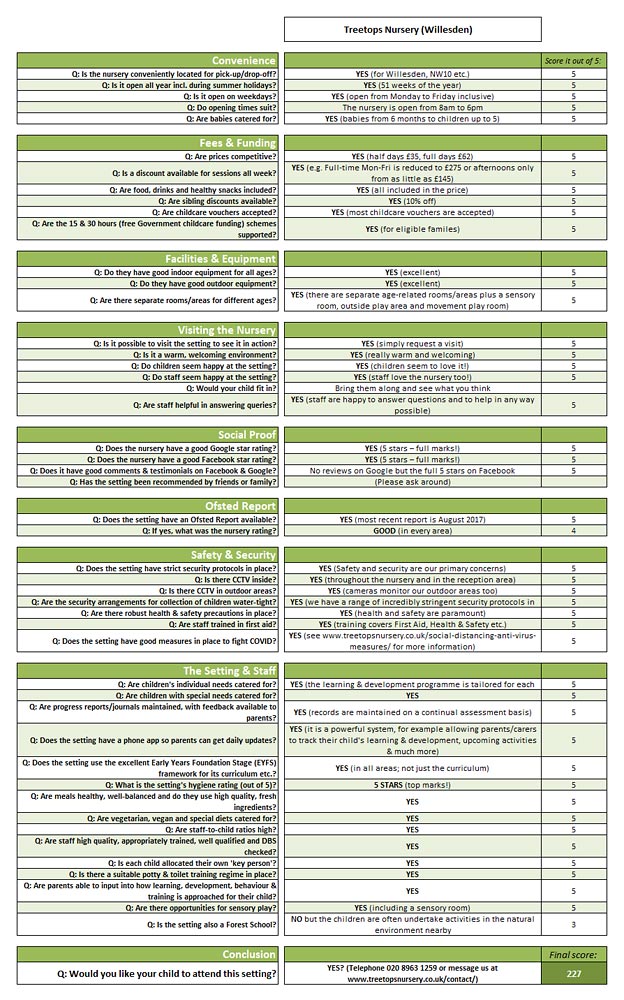

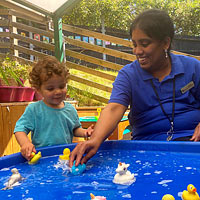 Equipment and facilities at the nursery are excellent, both indoors and outside. An excellent
 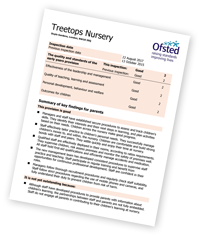 A Good Ofsted Report
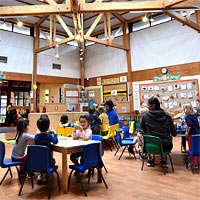 Children’s individual needs, including for those with special needs, are well catered-for at Treetops Nursery, Willesden. In fact, a learning and development programme is tailored to the needs, strengths, weaknesses and interests of each individual child. A ‘Key Person’ is also assigned to each child and this staff member continually monitors their progress, making changes to the tailored programme as appropriate as time goes by. Parents and carers are kept fully informed of children’s progress, including via a journal that is kept for each child. Parents are also free to add notes to the progress journal so a more complete picture is maintained for every child.
 Healthy, Balanced Meals for Children
 The Benefits of Healthy Eating for Children
 What Should Children be Eating & Drinking?
 Portion Sizes
 Healthy Eating at the Nursery
 The Adverse Effects of Too Little Sleep
 You can see that they require a little less sleep as they grow progressively older.
 A Peaceful, Quiet, Bedroom Set-up
 Stimulants should be avoided before bedtime. Drinks containing caffeine will keep children awake, so none should be given any time after lunch time, ideally. Caffeine can be found in some fizzy drinks and energy drinks, as well as in tea and coffee. Warm milk, in contrast, will be non-stimulating and actually quite soothing. Be careful not to give drinks too close to bedtime, though, and remember to get the child to visit the loo before going to bed, otherwise they may need to wake up in the night to pay a visit.
 Children Visiting in the Night