
A Good Ofsted Report for Treetops Nursery
One of the first things people should look at before settling on a nursery for their children is the latest Ofsted Report for the setting. After all, it’s wise to check the professional and independent feedback that such reports contain. On this note, parents and carers considering Treetops Nursery for their baby or child will be pleased to know that we passed with flying colours in its most recent Ofsted Report. Although it’s been a while since that report, we thought we’d share the outcome so that parents can see for themselves just how good a nursery Treetops is. In fact, we were rated as a good nursery in every single category and we’ll cover that in more detail below.
Treetops Nursery passed with flying colours
First, though, we’ll explain a little about Ofsted and what they checked for during the most recent inspection.
Ofsted
Ofsted is the UK’s official “Office for Standards in Education, Children’s Services and Skills”. As such, they inspect services providing education and skills and regulate services that care for children and young people. This includes childcare settings, nurseries and pre-schools throughout the UK. Ofsted inspections and the resulting reports are part of this governance.
 What they checked
- The Ofsted Inspector observed the quality of the teaching during various activities, both inside and outdoors. They then appraised the impact of this on the children’s learning.
- During the inspection, the Inspector talked with both staff and children, at appropriate moments throughout her visit, to further her insight.
- Joint observations were also undertaken by the Ofsted Inspector, in tandem with the nursery manager and room leaders.
- Meetings were also held with the nursery manager and area manager.
- Documentation was checked by the Inspector. This included ensuring that nursery staff were checked in terms of suitability, training and qualifications for the jobs they were undertaking. These checks would also, of course, ensure that all staff had been checked and deemed suitable for working with children.
- The Inspector also spoke with parents during her visit as well as reading through written feedback supplied by them. All such comments and feedback were taken into consideration when putting together the final Ofsted Report.
The Ofsted Inspector’s Conclusion
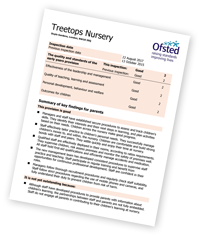
In her final Ofsted Report, the Inspector said …

 Healthy, Balanced Meals for Children
 The Benefits of Healthy Eating for Children
 The Adverse Effects of Too Little Sleep
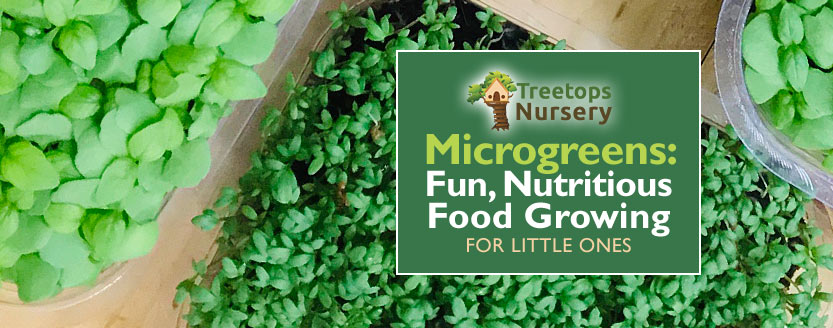
 There is one class of edible plant that can be grown all year round and is perfect for kids to grow indoors, for example on a windowsill. Some types of this food will sprout in as little as a week. What’s more, it’s tasty and highly nutritious. Growing it is super-easy and a perfect way to keep kids entertained, educated about nature and eating healthily. It’ll also be a welcome addition to mealtimes for the whole household.
 Here are just a few examples of plants that make suitable microgreens and can easily be grown by children indoors:
 Fennel — just 10 days after first sprouting, leaves from young fennel seedlings will give a pleasant aniseed tang to dishes like pasta salads, risottos, soups and even stuffing.
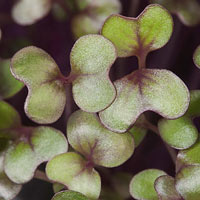 Red Cabbage micro leaves have one of the highest Vitamin C concentrations of any microgreen. They also contain Vitamin K, potassium, beta-carotene, calcium, magnesium and antioxidants. As with many of the microgreens, many top chefs use them as an attractive and tasty garnish. They can be sprinkled over soups, salads, grilled vegetables, stews and cooked meats. After sowing, they take only days to appear.


 Have you heard about the free childcare funding that’s available for eligible 2-year-olds? Do you want to learn more? If you are a parent who is looking to work, or perhaps to get back into work after starting a family, then this could be a perfect solution for you and your toddler. Under a Government scheme, approved nurseries, pre-schools and childcare providers in England can supply up to 15 hours per week of childcare for eligible 2-year-olds. It’s an absolute no-brainer, so we thought we’d put together this comprehensive guide to tell you everything you need to know.
 Back in July, we wrote a detailed article about
  hat’s incredible when you bear in mind that the children studied were, on average, just 3¼ years old. An 8 month skills boost is therefore equivalent to an extra fifth of their entire lives! Such an impact, at a time when they’re right in the middle of their pre-school years, is incredibly important for them. After all, this is a critical time in their learning and development — and one that will have a profound impact on the rest of their lives.
 If your child’s refusal to eat certain foods is making you stressed, take a moment to realise that this is perfectly normal. Indeed, many toddlers go through such a phase in their earliest years. If they’ve recently been breastfeeding, they will have become accustomed to a sweet-tasting diet. When they are weaned onto solids and suddenly become mobile, it’s natural for them to be wary of eating just anything — it’s so new to them. In fact, refusing some foods is an instinctive survival mechanism. It’ll take time for them to become accustomed to new tastes and textures.