 Treetops Nursery adheres to the Early Years Foundation Stage (‘EYFS’) framework. This is a structured approach to learning and development for under-fives and is prescribed, by the UK Government, for childcare settings such as ours. It covers 7 key areas of focus for learning and development, which are explained concisely on our Curriculum page. Today, we look at the Early Learning Goals that are integrated into the EYFS framework, including how and why they are used in nurseries and pre-schools.
The Purpose of the Early Learning Goals
The Early Learning Goals (‘ELGs’) are used as a way for early learning practitioners and childcare professionals to continually gauge the progress of each child’s learning and development. Specifically, they’re used as incremental benchmarks to help ensure that children are successfully heading towards ‘school readiness’ by the time they leave early years settings around the age of 5. This is the point when they move to Reception Year at primary school.
“The ELGs should support teachers1 to make a holistic, best-fit judgement about a child’s development, and their readiness for year 1.” (Department for Education, Statutory Framework for the Early Years Foundation)
Children are assessed continually against Early Learning Goals that are appropriate for their age. A ‘Key Person’ assigned to each child is a critical part of this. The assessment allows the Key Person and other childcare professionals to tailor the individual learning and development programme so that it is customised to the strengths, interests and any weaknesses of each child.
Parents/carers are also kept informed at all stages and are indeed encouraged to continue helping their child towards the same goals when at home. This tandem approach has been shown to have enormous benefits for the child, both in the short and long term.
Furthermore, if a special educational need is identified during assessment, families and childcare practitioners can then discuss more specialist, professional support for the child, should it be deemed appropriate. Setting goals, and monitoring performance against them, is a great way to identify such needs.
The Goals
In essence, though, the Early Learning Goals are designed to help children become naturally curious, with an enthusiasm to learn, to help them form healthy relationships with adults and peers, and generally to thrive as individuals. Some examples of the types of goals follow …
• Communication and Language Goals
 Goals for Communication & Language, a prime area of focus within the EYFS framework, include performance against benchmarks for attentive listening, responding appropriately to what they’ve heard, speaking skills, good use of English and self-expression skills.
• Personal, Social and Emotional Development Goals
Goals around physical development, the 2nd of the prime focus areas within the EYFS, include good self-regulation in terms of behaviour around others, demonstrating patience in respect of needs, wants and any impulses, following instructions appropriately, demonstrating confidence and perseverance when challenged, personal skills like independence, the building of good relationships with others and even understanding healthy food choices.
• Physical Development Goals
 Goals for physical development, the third of the prime focus areas of the EYFS, centre around gross and fine motor skills. For their gross motor skills, goals are set for skills like negotiation around spaces and obstacles, appropriate movement skills for doing so, suitable balance, strength and coordination skills. With regard to fine motor skills, goals are set around things like the ability to appropriately hold and use writing instruments and tools, and demonstrating accuracy when doing so.
• Literacy Goals
Goals for literacy include several around comprehension, vocabulary, reading and writing, understanding letters and words, phonics and spelling.
• Mathematics Goals
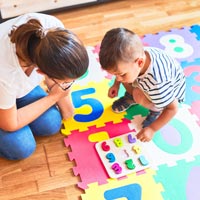 These include understanding numbers, counting, recognising patterns within numbers and number systems, comparison and comprehension of quantities, recalling number bonds and recognition of odds, evens, etc.
• Goals for Understanding the World
These goals cover quite a bit of ground including comprehension and knowledge about people, roles and society around the children as well as more distant, the past and the present, different cultures, other religions and countries, plus a knowledge of the natural world.
• Goals for Expressive Arts & Design
Goals in this specific category centre around use of creative materials, techniques and tools along with creative expression skills themselves. As well as exploring colour, design, form, function and suchlike, children will be expected to appropriately share their creations, speak about them and perform any stories, songs, rhymes and so on.
“Practitioners must consider the individual needs, interests, and development of each child in their care, and must use this information to plan a challenging and enjoyable experience for each child in all areas of learning and development.” (Department for Education, Statutory Framework for the Early Years Foundation)
Progress Check at 2
A key part of the ongoing assessment against the Early Learning Goals is a progress check at the age of two. Parents/carers will be provided with their child’s assessment at that age and it will include findings in relation to the child’s strengths and any areas that are below expectations. This can then be used “to develop a targeted plan to support the child’s future learning and development involving parents and/or carers and other professionals (for example, the provider’s Special Educational Needs Co-ordinator (SENCO) or health professionals) as appropriate.” More details about the progress check can be found on pages 18 and 19 of the EYFS document (a link is provided in the grey box earlier in this article).
A Great Childcare Nursery in Willesden (near Harlesden & Kensal Green)
 Treetops Nursery is a wonderful nursery in Willesden, London NW10, also suitable for those looking for nurseries or pre-schools near Harlesden, Kensal Green and Willesden Green. Ofsted recognise that we offer “good standards and quality of early years provision”, “good quality of teaching, learning and assessment” and most importantly “good outcomes for children”. If you’d like your baby, toddler or preschooler to benefit from our high quality childcare service, please get in touch and we’ll be happy to show you around, answer questions and more …
1. For the purpose of this article, the term ‘teacher’ is a placeholder for any type of practitioner working with a child.
 Today, we look at another condition that can affect children: dyscalculia. This is a brain-related learning difficulty that affects both children and adults. Somewhere between 3 and 6 percent of the UK population is affected and some may also have other conditions like
  The Diagnostic & Statistical Manual of Mental Disorders (DSM-5), as used by psychiatric professionals in the U.S., describes how those with developmental dyscalculia have problems making sense of numbers, memorising arithmetic facts and making fluent and accurate maths calculations. Clearly, such limitations can have a profound effect, including in terms of education because maths affects so many learning topics.
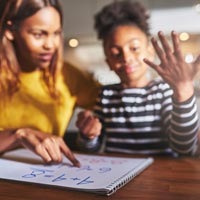 They may be more prone to continue using their fingers to count, long after their peers have moved onto mental arithmetic.
 Use of lined or graph paper can sometimes help too, so as to keep corresponding numbers in line and steps more clear.
 A: Dyslexia is categorised as a Specific Learning Difficulty (‘SpLD’) in the UK. Most notably, it adversely affects a person’s ability to read because of a general difficulty in learning or interpreting letters, words, and often other symbols. Indeed, it was originally referred to as word blindness. There are other ways dyslexia affects people, though, and we’ll come to those in more detail later.
 A: As it’s a genetic issue, people are born with the condition. Symptoms may begin to show as a child matures during early learning and beyond. As it is something that’s inherent in their physiology, it is not something people can ‘grow out’ of. It is a lifelong issue. It can be managed, of course, with various approaches available to mitigate its effects as far as possible.
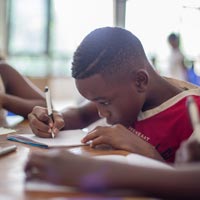 They may also have trouble remembering words.
 A: Being unable to easily read will hold children back. If they have trouble reading, they will have trouble reading text books for any of the topics at school. Some classroom and test situations will become more stressful for them as a result.
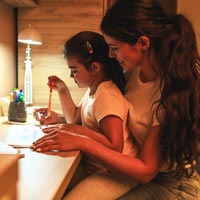 One-to-one help from a teacher, teaching assistant or specialist;
 A: Childcare professionals will be on the look-out for any signs of possible dyslexia (see the list of possible signs earlier in this article). Parents can do the same and, because the condition is thought to be inherited, this is particularly important if one or more of the child’s parents is dyslexic. Signs can be hard to spot, but the earlier the condition is recognised, the sooner the child can be helped. If any signs of possible dyslexia are suspected, supervising adults and childcare professionals can initially monitor the child’s progress going forwards. They can also assess the child against benchmarks for the same age or peer group in case it’s just a temporary blip in their learning progress.